SlopStreet / A case study
The Binance incident, explained from scratch.
A crypto wallet received a powerful permission. Then money moved. Here is how to follow the evidence, one step at a time.

Six things to know.
Crypto in this case means digital assets recorded on the Ethereum network. Start with these six ideas; come back whenever you need them.
Exchange
A service where people can buy, sell and hold crypto. Binance is one example.
Blockchain
A shared record of transactions. Ethereum’s record is public, so anyone can inspect addresses and transfers, but it does not automatically show people’s names. A block explorer is a search tool for that record.
Wallet and key
A wallet is an account or tool for managing crypto. Its address identifies it; a secret key can produce a digital signature that approves an action.
ETH
The main asset of the Ethereum network. ETH is not a promise from a single stablecoin company and its price can rise or fall.
Tokens and stablecoins
A token is a digital asset recorded by a program on a blockchain. A stablecoin is a token designed to follow a price, often $1. USDT, USDC and RLUSD are different stablecoins; their prices can still move away from $1.
Smart contract
A program on a blockchain. It can hold or move tokens according to its code. Some token programs also allow their issuer to block certain addresses.
One more useful word: a snapshot is a freeze-frame of the record at a particular time. Balances can change after that moment.
What happened?
On 29 October 2026, a crypto account labelled as belonging to the exchange Binance accepted a signed instruction that let it run another program. A few minutes later, large amounts of crypto began moving from Binance-labelled accounts into one receiving account. Other transfers followed.
Some of the money was stopped by the companies behind certain digital tokens. Some had already been moved or exchanged. In the particular Ethereum accounts we checked, about $2.244 billion in stablecoin tokens was frozen, counting each token as worth $1. We checked the records up to 00:11:59 UTC on 30 October.
Binance said it was investigating and that user funds were safe. Its founder said it looked like a hack. Public records cannot yet tell us the final loss, whether customers will lose money, or who was responsible. Associated Press reporting
First, the story.
All times use UTC, a standard world clock. These are the public records we could check; why the permission was signed remains unknown.
A permission takes effect
One signed instruction lets Binance 14 run a specified program.
Assets start moving
A large transfer leaves Binance 14 for a receiving wallet.
The trail branches
ETH and stablecoins move, some tokens are traded, and USDT is used to support a loan.
Some tokens are frozen
The receiving wallet is blocked by the USDT and USDC token programs. Later arrivals increase its frozen balance.
The permission is removed
Binance 14 stops pointing to that program. The investigation continues.
Watch for this: a transfer, a trade, a frozen balance and a repayment are four different things. One amount can appear in several stages of the same trail.
Step 1: the permission.
Think of a signed permission as an instruction a wallet is allowed to accept. At 20:20:59 UTC, the Ethereum record shows that an account called Binance 14 accepted one such instruction. It allowed the account to run a particular program when called.
The instruction used an Ethereum feature called EIP-7702, which can also be used for ordinary wallet functions. One transaction contained 50 candidate permissions; one took effect. The other 49 did not match the account’s required sequence number. This is evidence of one successful permission in that transaction, not 50 successful break-ins. See the transaction
A few minutes later, assets moved. Another address submitted the transaction, but the permission needed a valid signature from Binance 14. That does not tell us how the signature was obtained. A stolen key, a tricked approval or misuse of a signing system are possibilities; the public record does not identify the cause. It also does not establish that Ethereum itself was broken.
A permission is signed
One instruction worked. We do not know how the signature was obtained.
Binance 14
The instruction let this account run a specified program.
0x28C6…1d60
Hot Wallet 34
Its account record names Binance 14 as its owner.
0xEe7a…4055
780m USDC
The transaction record shows 780 million USDC sent to the receiving wallet.
The record shows Binance 14 acting through Hot Wallet 34 to move USDC. It does not tell us how the signature was obtained. We also cannot explain the separate Binance 16 transfers from this link alone.
Step 2: follow the money.
Three accounts labelled as Binance wallets sent assets to the same receiving wallet. We call it the collector because of what it did: it collected the transfers. That name does not prove who controlled it. The figures below are different kinds of assets, so we keep their units separate. In the charts, m means million and bn means billion.
The collector received about 1.875 billion USDT, a token designed to track $1. It then sent 700 million USDT to two other wallets. From those branches, 435 million was traded for ETH, 60 million was used to support a loan, and almost 205 million was found frozen in two later wallets. A tiny remainder also moved out.
Separately, about 1.175 billion USDT was frozen at the collector. The collector also received 823 million USDC and 88.541 million RLUSD, plus ETH and other tokens. Some RLUSD was swapped too. Do not add a token transfer and the ETH received for it as if they were two separate losses: they can be two stages in the same money’s journey.
Explore the money trail
Each box is a wallet, action or destination. An arrow shows a connection. Select a box to read what we found and open the supporting record. Box sizes and line thickness do not show how much money moved.
What happened to the USDT we followed
About 1.875 billion USDT entered the receiving wallet
These are parts of the same USDT trail, rounded for readability. The exact calculation also accounts for 127.672480 USDT sent out and 0.01 USDT of unrelated extra receipts. This chart does not show the total loss.
Step 3: some tokens are stopped.

The companies behind USDT (Tether) and USDC (Circle) can block those tokens from being sent out of specific addresses. Imagine a gift card whose issuer stops it being spent: the balance can still appear on a screen, but the blocked address cannot use it normally. The company behind RLUSD (Ripple) used a similar control on another address.
- 01Frozen
The token company blocks an address from sending those tokens. - 02Returned
Someone receives the assets back, or an issuer replaces them. That needs separate evidence. - 03Final loss worked out
Count what was affected, subtract what was actually recovered, and check the obligations involved.
A freeze does not rewind earlier transfers or automatically give the tokens back. It also did not turn off the original wallet’s ability to send more funds. After the first USDT freeze, another roughly 200.4 million USDT arrived at the collector and was added to the blocked balance. See that later transfer
At 00:10:35 UTC the next day, the permission to run the program was removed from Binance 14. That is an important response. The record does not tell us who removed it, whether the keys were replaced, or whether the original problem was fixed. See the removal
The detailed timeline
Selected events, in order. All times are UTC. The gaps are not drawn to scale.
- One permission works
A signed instruction allows Binance 14 to run a specified program. We do not know how the signature was obtained.
- The first large transfer
167,464.25 ETH and 63 token transfers leave Binance 14. USDT and RLUSD in this transfer are already included in our totals.
- A linked wallet sends USDC
Hot Wallet 34 sends 780 million USDC to the receiving wallet. Another 43 million follows at 20:59:47.
- USDT supports an ETH loan
An account puts up 60 million USDT as security and borrows 19,762.41 ETH in two parts.
- Token companies block balances
The receiving wallet is blocked by the USDT and then the USDC token programs. More funds arrive later.
- Another transfer gets through
About 200.4 million USDT and 369.83 ETH move to the receiving wallet after the blocks.
- The permission is removed
Binance 14 no longer points to the program. We cannot tell who removed it or whether the original problem was fixed.
Step 4: a loan makes the story more complicated.
Some USDT ended up in Aave, a set of programs people can use to lend or borrow crypto. The account we followed put up 60 million USDT as collateral: something pledged to support a loan. It then borrowed 19,762.41 ETH as the original loan amount.
Imagine borrowing one bicycle and promising to return one bicycle. If bicycles become more expensive, you still owe a bicycle, so the value of your debt has risen. Here the debt was in ETH and the collateral was in USDT. An ETH price rise, compared with USDT, makes the loan riskier if everything else stays the same.
At our snapshot the loan’s health factor was 1.05756. This is Aave’s measure of loan risk. Below 1, a loan can become eligible for liquidation: someone can repay some debt and receive collateral under the protocol’s rules. With the amounts and other inputs held fixed, an ETH rise of about 5.76% against USDT would bring the factor to 1. That is a scenario, not proof a liquidation happened. How Aave describes liquidation
One important detail: the borrower’s address was blocked for USDT, but the separate Aave contract holding the collateral was not blocked. The Aave USDT and WETH markets had restrictions on new deposits and borrowing. WETH is a token version of ETH. These facts do not establish that Aave lost money.
Try it: select −10% on the slider. With everything else held fixed, the health factor rises to about 1.175: this loan becomes less risky when ETH falls relative to USDT.
scenario
What the slider assumes: only ETH’s price changes compared with USDT. The loan size, collateral amount and protocol settings stay fixed. In real life, interest, prices and settings can also change. Below 1 a loan may be liquidated; that does not mean a liquidation or loss has happened.
Step 5: could the shock spread?
The first effects we can see were a signed permission and crypto leaving wallets. Token issuers then blocked some balances; later the wallet’s permission was removed. At our snapshot, the Aave markets we checked also restricted new deposits and borrowing. We did not independently verify when or why those Aave settings changed.
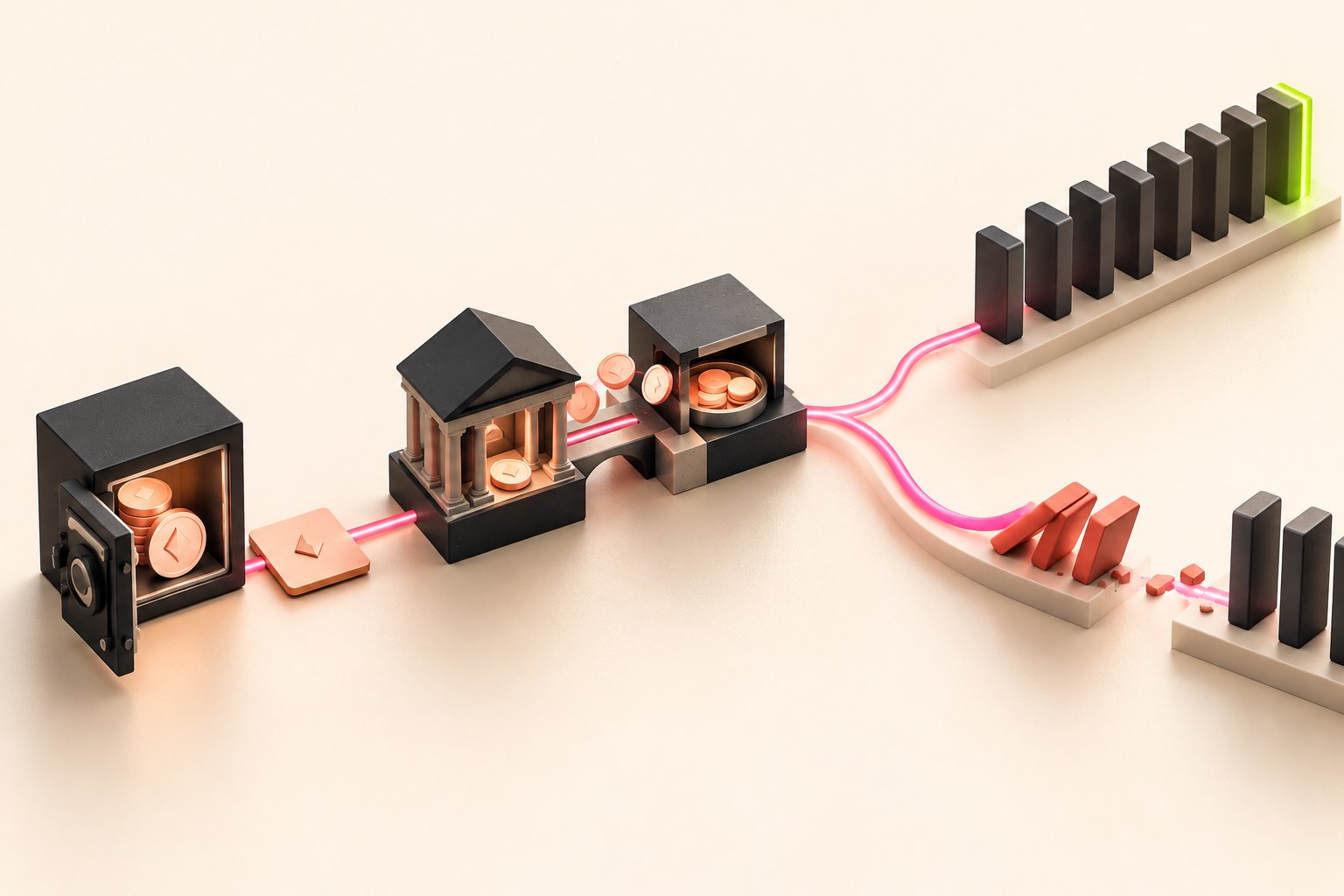
Further effects are possibilities. If a large exchange is disrupted, people may want to withdraw money while trading firms search for funds elsewhere. That could make trading harder or increase the gap between buying and selling prices. Some traders might have to sell assets to meet their debts. The arrows below show possible routes; they do not prove these outcomes happened.
Another possible path is that the accounts are secured, assets are returned and normal service resumes. To know how much was actually recovered, we would need evidence of those returns, not just a freeze notice.
What we still need to learn.
We do not yet know exactly how the permission was obtained, who was behind the activity, the full amount affected across every blockchain, or how much will be returned. We also cannot check all of Binance’s customer obligations and available reserves from these wallet records alone.
How did it start?
A detailed investigation of the signing process could show how the permission was obtained. The public signature alone cannot answer that.
How much was affected?
Investigators need a list of affected assets across every relevant blockchain, without counting the same money twice. We do not have a verified final loss.
How much came back?
A frozen balance shows a block. A return needs evidence that the asset was actually sent back or replaced.
What happened to customers?
To check whether customers can access their money, we would need reliable figures for what Binance owes and what assets it can readily use, as well as evidence about service access.
The lesson is to follow each step, keep the units straight, and ask what the evidence can tell us and what it cannot.
Check your understanding.
Pause for a moment. Choose a question to reveal an explanation.
If 100 tokens move through three wallets, were 300 tokens necessarily lost?
No. The same 100 tokens can appear in three transfer records. You must follow the same units and avoid counting them again at every stop.
Does a frozen balance mean the owner has been paid back?
No. A freeze blocks certain movements. Returning or reissuing the tokens is a separate action that needs its own evidence.
Why could a rise in ETH make this particular Aave loan riskier?
The borrower owes ETH but put up USDT. If ETH rises against USDT, the debt becomes more valuable compared with the collateral, assuming the other inputs stay the same.
Connected evidence · 30 October 2026
There’s more to the picture.
This map shows the observed asset paths in the case study’s existing evidence. It covers the traced subset at the snapshot, not the full incident.
Drag to rotate · pinch or use the controls to zoomLoading connections…
Where did we get this?
Music context and sources
Recorded 2 November 2026. The on-chain authorisation was at 20:20 UTC on 29 October. The four-wallet frozen figure is a 30 October snapshot; Binance’s 95% replenishment update is from 1 November. Replenishment is not the return of stolen assets.
We checked public Ethereum transaction records and account settings at the time shown. Our working files contain 335 distinct token-transfer records and copies of 189 responses from public data services. Wallet names come from blockchain explorers; they do not prove a person’s identity.
Names on tokens can be copied. We checked the actual token programs and excluded a fake transfer using a lookalike USDT name. An arrow between two addresses does not prove the same person controlled both.
The links below lead to transaction records, the protocols’ own explanations and news reports. We did not check all the other blockchains, Binance’s private accounts or the identities of the people involved.
Editorial cut-off: chain state 30 October 2026, 00:11:59 UTC; contextual reporting rechecked during preparation at approximately 00:55 UTC. This article reflects the evidence available at those times. Later transfers or statements may change the assessment.